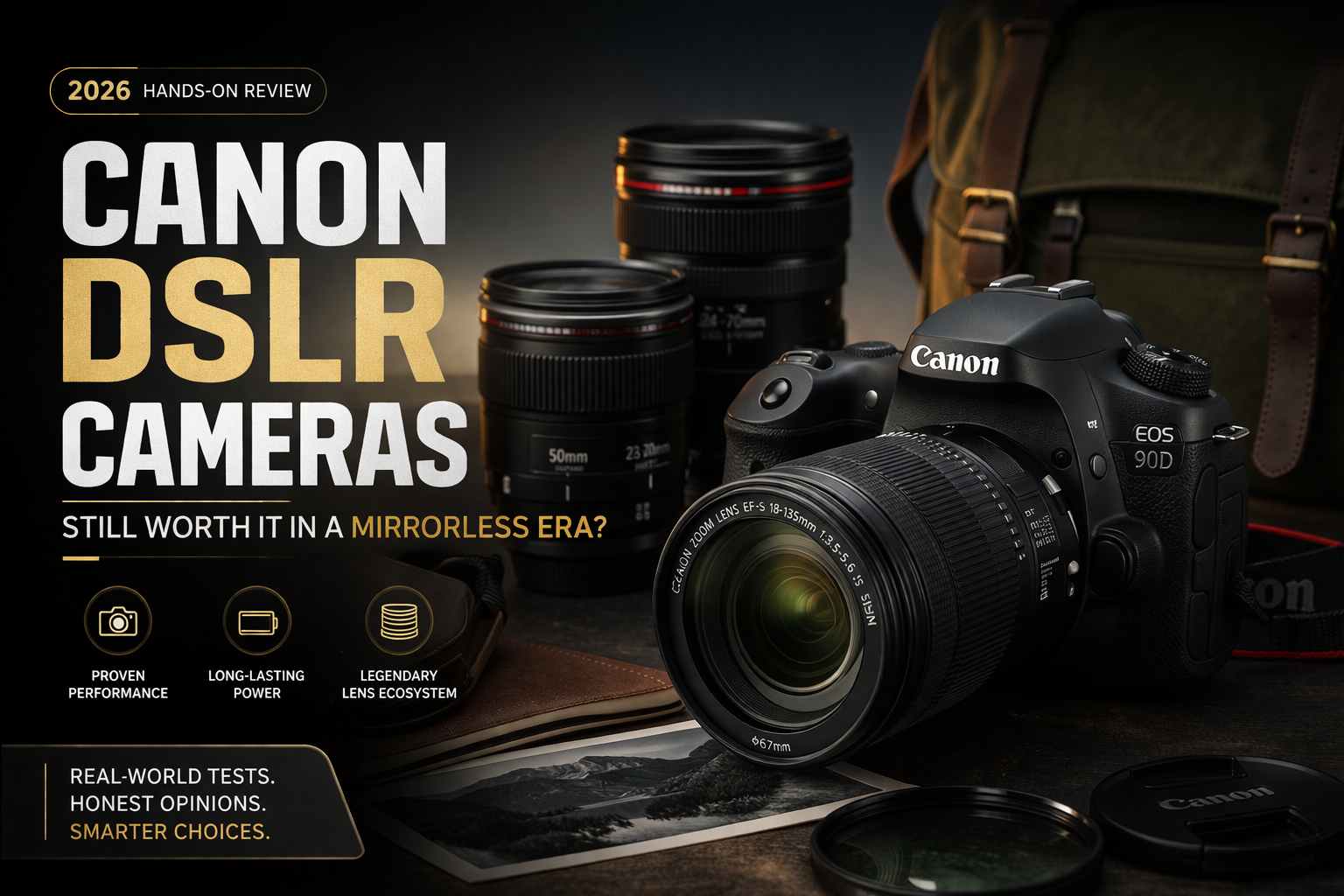
There’s something reassuring about the solid grip of a Canon DSLR. The tactile feedback, the optical viewfinder, the familiar click of the shutter. While mirrorless cameras keep stealing the spotlight, Canon DSLR cameras haven’t quietly faded away. In fact, they continue to hold ground for photographers who value reliability, battery endurance, and a proven ecosystem.
Canon has spent decades refining its DSLR lineup, and it shows. From entry-level bodies to full-frame workhorses, the brand delivers consistency that many users trust without second guessing. The question now isn’t whether DSLRs are outdated. It’s whether they still make sense today. And the answer depends on what you expect from your camera.
Canon DSLR Camera Performance and Real World Reliability
Canon DSLR camera reviews often highlight one key strength: consistency under pressure. Whether shooting weddings, wildlife, or street photography, these cameras rarely miss a beat. Autofocus systems like Dual Pixel AF deliver accurate subject tracking, especially in mid to high tier models.
Low light performance remains impressive, particularly in full-frame models such as the EOS 6D or 5D series. Noise control is well managed, and color science remains one of Canon’s strongest advantages. Skin tones look natural straight out of the camera, reducing post-processing time.
Battery life is another area where DSLRs still dominate. Unlike mirrorless cameras that rely heavily on electronic displays, DSLRs conserve power thanks to optical viewfinders. That translates to longer shooting sessions without constantly swapping batteries.
Handling is where many photographers fall in love. The grip feels secure, the buttons are logically placed, and the menus are intuitive. It’s a system that prioritizes usability over novelty. If you’re curious why many professionals still stick with this system despite newer trends, this deeper breakdown explains it well: Canon DSLR Cameras: Why They Still Dominate Photography in a Mirrorless World.
Best Canon DSLR Cameras for Different Needs
Choosing the right Canon DSLR depends heavily on your skill level and shooting style. Beginners often gravitate toward models like the EOS Rebel series. These cameras are lightweight, affordable, and easy to learn. Despite their simplicity, they still deliver impressive image quality, making them a strong entry point, as explored further here: Disclosing the Power of the Canon EOS Rebel T100 DSLR Camera with 18-55mm Lens.
For enthusiasts, models like the EOS 70D or 80D strike a balance between performance and price. They offer advanced autofocus, better build quality, and more control over settings. These cameras are ideal for content creators who want flexibility without jumping into full-frame territory, and this detailed look gives a clearer picture: Canon EOS 70D DSLR Camera: A Smart Choice for Creators Who Want More Control.
Professionals usually lean toward the EOS 5D Mark IV or similar models. These cameras offer exceptional dynamic range, superior autofocus systems, and rugged build quality. They’re designed to perform in demanding environments and deliver consistent results across various shooting conditions, which is why many still consider this model a benchmark: Canon EOS 5D Mark IV Full Frame DSLR with EF 24-70mm f/4L IS USM Lens: A Timeless Professional Choice for Serious Creators.
Full-frame lovers who want strong low-light performance without going too high in budget often land on the EOS 6D, a camera that continues to impress with its balance of price and output, as explained in this closer review: Discover the Magic of the Canon EOS 6D Camera.
Canon DSLR vs Mirrorless: Practical Differences That Matter
Mirrorless cameras bring innovation, but Canon DSLRs bring stability. That’s the trade-off. Mirrorless systems offer faster burst rates, real-time exposure previews, and compact designs. But DSLRs counter with durability, longer battery life, and a mature lens ecosystem.
Optical viewfinders give a natural, lag-free view of your scene. Many photographers still prefer this over electronic displays, especially in fast-paced environments like sports or wildlife photography.
Another factor is cost efficiency. DSLR systems often provide better value, especially in the used market. Lenses are widely available, and accessories are easier to find at lower prices. For someone building a complete photography kit, that matters.
That said, DSLRs are not trying to compete on cutting-edge features. Instead, they excel at delivering dependable performance where it counts.
Image Quality and Lens Ecosystem Advantage
Canon DSLR cameras benefit from one of the largest lens ecosystems in the industry. From budget-friendly primes to professional L-series lenses, options are abundant. This versatility allows photographers to adapt to any shooting scenario without switching systems.
Image quality remains competitive even by modern standards. High-resolution sensors, accurate metering, and refined color processing ensure that photos look polished right out of the camera. RAW files provide ample flexibility for editing without degrading image integrity.
Depth of field control is another strong point. Full-frame DSLRs, in particular, produce beautiful background blur that portrait photographers love. Combined with Canon’s color science, the results often feel cinematic without heavy editing.
Who Should Still Buy a Canon DSLR Today?
Canon DSLR camera reviews consistently point to a clear audience. If you value reliability, affordability, and a proven system, DSLRs still make perfect sense. Beginners benefit from straightforward controls and accessible pricing. Enthusiasts enjoy the balance of performance and usability. Professionals trust them for critical work.
Content creators who prioritize video might lean toward mirrorless options. However, for photography-first users, DSLRs still deliver everything needed without unnecessary complexity.
There’s also a learning advantage. DSLRs encourage a deeper understanding of exposure, composition, and manual control. They feel less automated, which can be beneficial for skill development.
FAQ Canon DSLR Camera Reviews
- Are Canon DSLR cameras still good in 2026?
Yes, Canon DSLR cameras remain highly capable even in 2026. While mirrorless systems continue to evolve, DSLRs still deliver excellent image quality, strong battery life, and reliable autofocus. Many photographers prefer them for their durability and optical viewfinder experience. They are especially relevant for users who prioritize photography over video and want a stable, proven system without frequent upgrades. - Which Canon DSLR is best for beginners?
For beginners, models like the Canon EOS Rebel T100 or similar entry-level DSLRs are ideal starting points. They offer simple controls, guided interfaces, and solid image quality without overwhelming new users. These cameras help build foundational photography skills while remaining affordable. Over time, users can upgrade lenses and bodies within the same ecosystem without starting from scratch. - Is it worth buying a DSLR instead of a mirrorless?
It depends on your priorities. DSLRs are worth buying if you value longer battery life, lower cost, and access to a wide range of lenses. They are also more comfortable for extended shooting sessions. However, if you need advanced video features, compact size, or cutting-edge autofocus, mirrorless may be the better option. Both systems have strengths, but DSLRs still hold strong value for many photographers.
Canon DSLR cameras aren’t chasing trends. They’re built on years of refinement, delivering dependable performance where it matters most. For many photographers, that’s more than enough reason to keep choosing them.